Why Spelling Is the Missing Piece in Your Phonics Instruction
Here's why encoding deserves as much instructional time as decoding, how LitLab builds it into every story, and what 50,000+ real student attempts taught us about where kids actually get stuck.
The Word Caller Problem: Why Fluent Readers Still Misspell
We've all seen this student: she reads aloud with near-perfect accuracy, and her oral reading fluency scores look solid. But hand her a whiteboard and ask her to write the word "chip," and something breaks down. She writes "chp." Or "cip." Or she just freezes.
What she hasn't built yet is the deep phoneme-grapheme connections that would let her produce that same word independently, from sound alone. And she's far more common than most of us realize, because oral reading accuracy is the number we usually check first, and it's the one most likely to mask this exact gap.
Reading and spelling develop together, but spelling often places greater demands on a student’s knowledge of sound-symbol relationships. Recognizing a pattern is cognitively easier than producing it from memory, so students typically learn to read words before they can spell them. That gap isn't a red flag by itself — it's expected. The problem is when it never closes, because we never give students structured practice on the encoding side.
What the Research Says: Encoding as a Window Into Mastery
The National Reading Panel found that systematic phonics instruction improves spelling ability across grade levels, with the strongest effects in kindergarten. But the finding that matters most for daily practice is this: spelling is one of the most reliable indicators of whether a student has truly internalized a phonics pattern — not just memorized what a word looks like on the page.
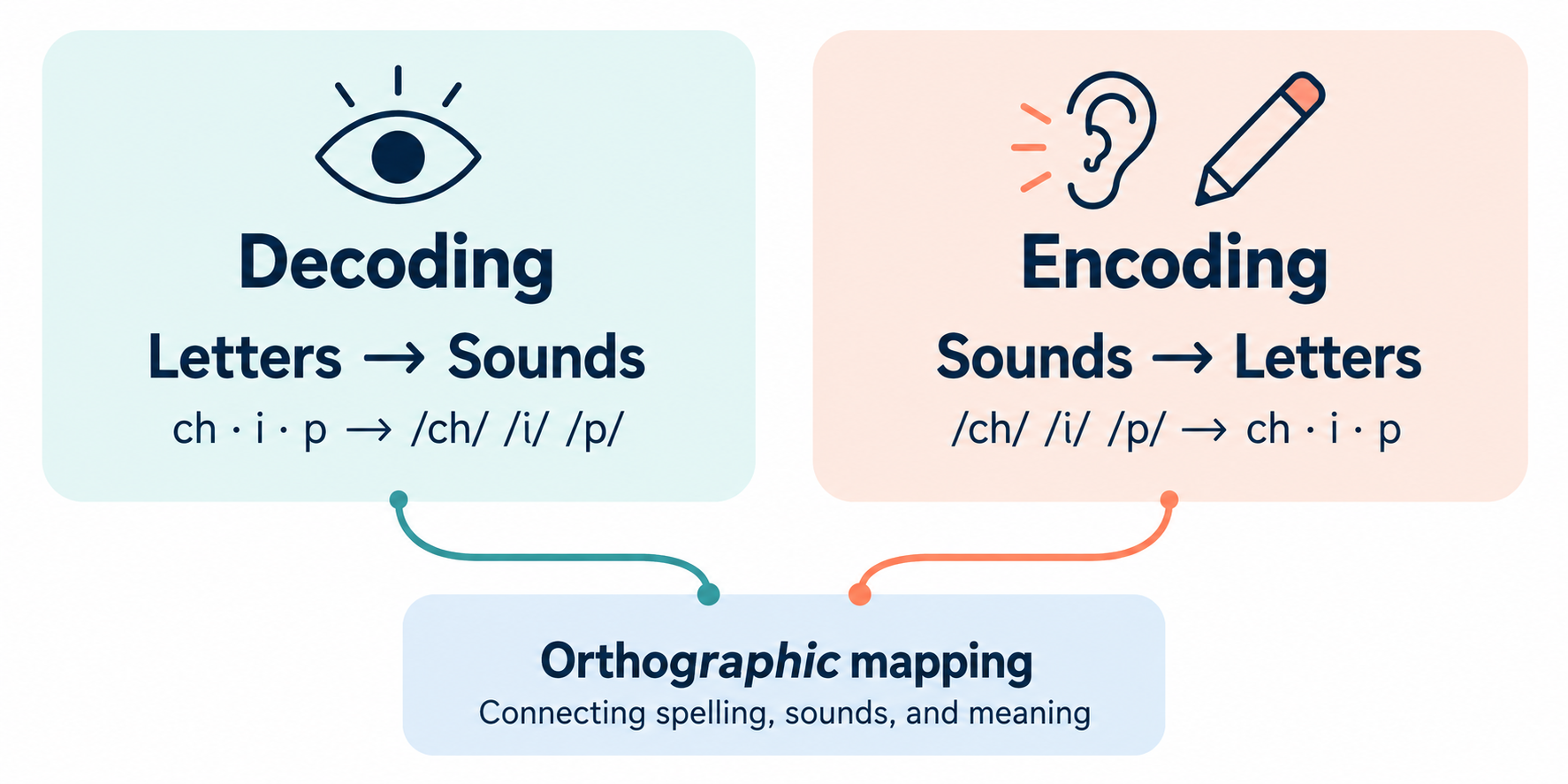
Here's why. When a student decodes, they're working from visual input: they see letters and convert them to sound. When they encode, they're working in the opposite direction — they hear a word, segment it into individual phonemes, and recall which letter or letter combination represents each sound. That reverse direction, sound to print, asks for a deeper level of phonics knowledge than reading alone does.
Researchers call this bonding process orthographic mapping — it's how a word's spelling, pronunciation, and meaning get wired together in long-term memory. Encoding practice strengthens exactly those bonds. And when the bonds are strong, students don't just spell better; they read more automatically too, because they've built a larger bank of words they recognize instantly rather than sound out.
Which is exactly why a student can score 98% on an oral reading fluency check and still stumble on basic phonics patterns at the whiteboard. Reading accuracy can hide gaps in true word knowledge. Spelling reveals them.
How LitLab's Spelling Activity Puts the Research Into Practice
Most structured literacy programs do include some encoding work — dictation, word sorts, whiteboard drills. In practice, though, it's the first thing to get squeezed. In a 90-minute literacy block juggling whole-group phonics, small-group rotations, and independent practice, the spelling dictation at the end of the lesson often shrinks from five words to two, or gets skipped outright — especially for the students who need it most.
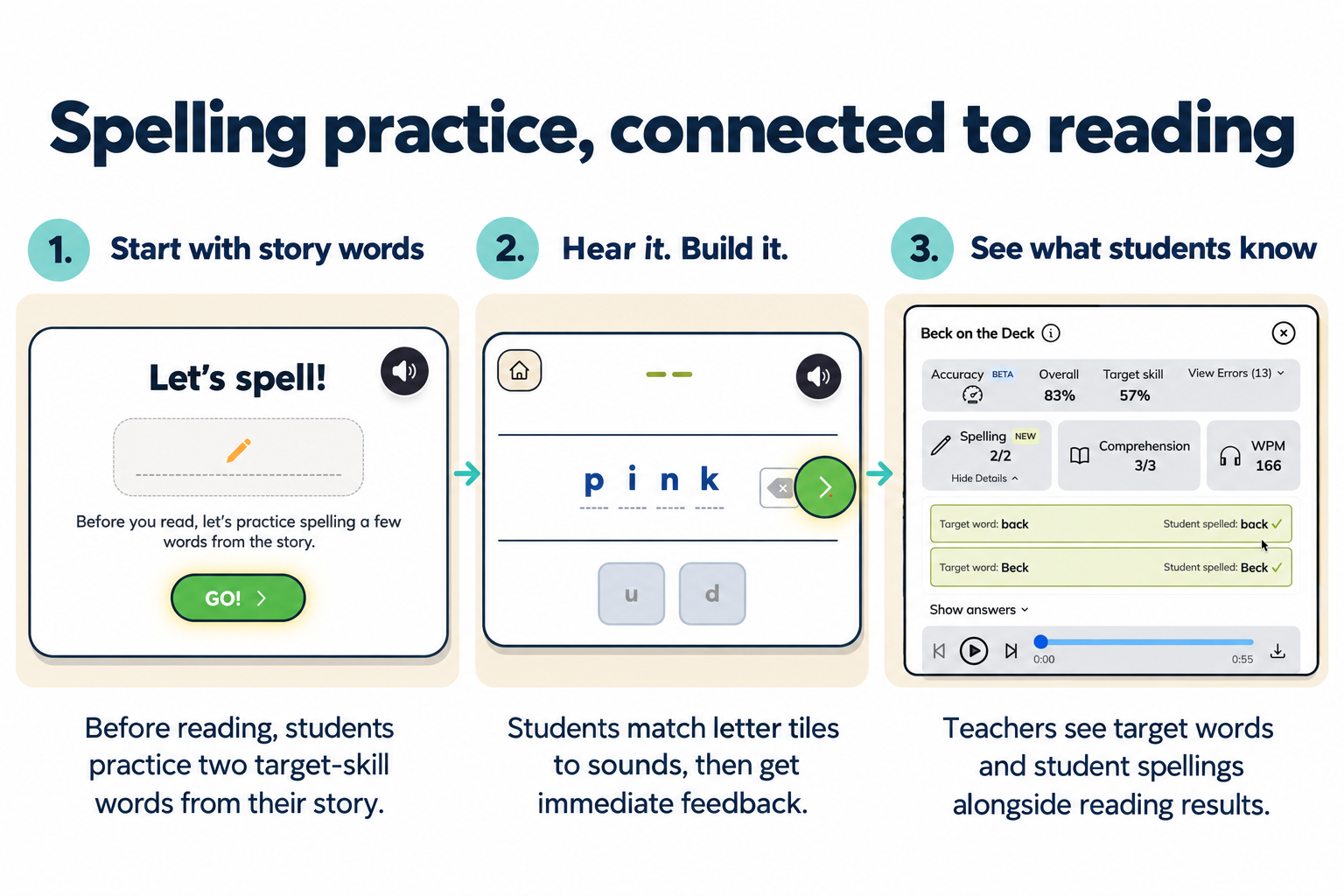
That's the gap LitLab's spelling activity was built to close. Before a student reads their assigned story, they now practice spelling two target-skill words drawn straight from that story — the same words, using the same phonics pattern their teacher is already targeting.
Students hear the word, then segment it into sounds
The activity opens with clear audio of a target word — a decodable word from the story the student is about to read. Students see phoneme lines on screen, one per sound in the word, the same visual scaffold as a physical Elkonin box or "sound box," which many teachers already use in small-group phonics lessons.
Students build the word with grapheme tiles
Students drag letter tiles into the correct sound slot. The tiles represent phoneme-grapheme units, not just individual letters — so a digraph like "sh" or "ch" appears as a single tile, just as it represents a single sound. That's a small design choice with a real research basis: it keeps the activity mapped to sound-to-print, not just letter-to-print.
Students get immediate, corrective feedback
After students submit a word, they immediately see which sounds they got correct and which need another try. They hear the word broken into sounds as each sound line is highlighted, without seeing the letters, then try spelling it again. After their second attempt, they see the correct sound tiles and hear the word broken down once more, reinforcing the connection between each phoneme and the word's spelling.
The words connect directly to the story
Because the target words are pulled straight from the story, the spelling activity gives us another window into how securely students know those words and patterns. In our data, words students spelled correctly were also more likely to be read correctly a few minutes later. When a student struggled to spell a word, that same word was more likely to be misread in the story — making spelling a useful same-day diagnostic signal of the underlying phoneme-grapheme connection.
Teachers see it without pulling a separate assessment
On the teacher dashboard, spelling results sit right alongside the oral reading data teachers already check. Click into a student's row, and you can see the target word next to exactly what the student typed, listen back to the student read aloud, and spot which phoneme-grapheme connections are solid and which are still shaky — a signal that oral reading scores alone won't always show.
Spelling Practice in Real Classrooms
The data below shows student spelling engagement since launch on March 15 through July 1, 2026, across classrooms using LitLab's Student Fluency Platform.
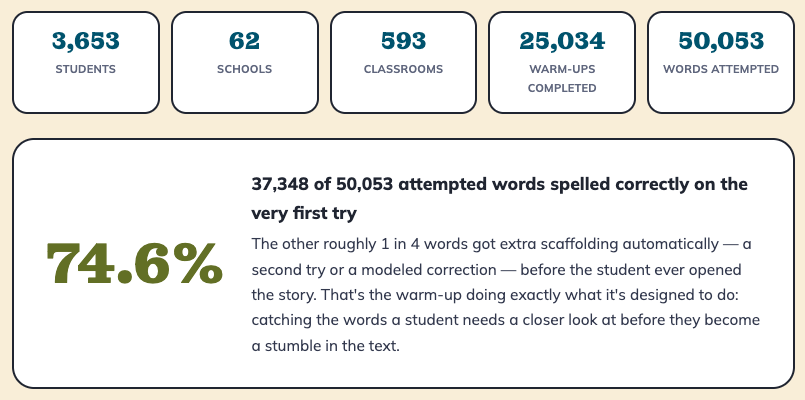
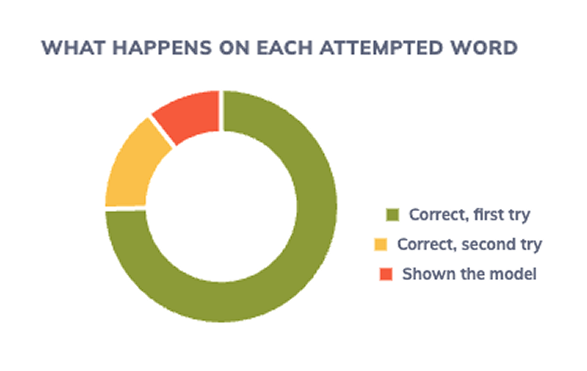
74.6% of attempted words (37,348 of 50,053) were spelled correctly on the very first try.
The other roughly 1 in 4 words triggered extra scaffolding automatically — a second try or a modeled correction — before the student opened the story. The warm-up activity is functioning as intended: identifying words that need more attention and giving students immediate practice before they encounter those same words in the text.
Where Students Get Stuck, According to the Data
An accuracy percentage tells you how much practice is happening. It doesn't tell you much about what to teach next. For that, the more useful number isn't how often students get a word right — it's what they write when they get it wrong. Those misses turn out to be remarkably consistent, and they line up closely with decades of research on how children's spelling develops (Ehri's phase model of word learning, Treiman's work on invented spelling).
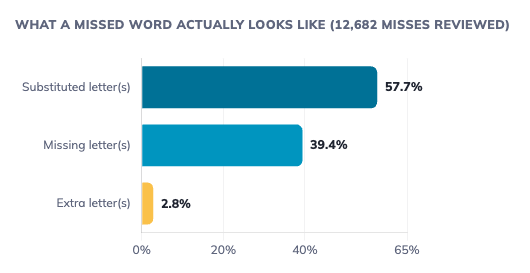
Of the 12,682 missed words, almost six in ten misses are a swapped letter — a plausible-but-wrong grapheme in place of the right one. Four in ten are a dropped letter. Kids are rarely adding sounds that aren't there; they're substituting or omitting, the same two patterns invented-spelling research has documented for decades.
The dominant confusion: short vowels
Zoom into just the vowel substitutions, and one pattern dominates: e and a get swapped for each other far more than any other vowel pair — e→a alone accounts for 205 of the 919 vowel mix-ups we reviewed.
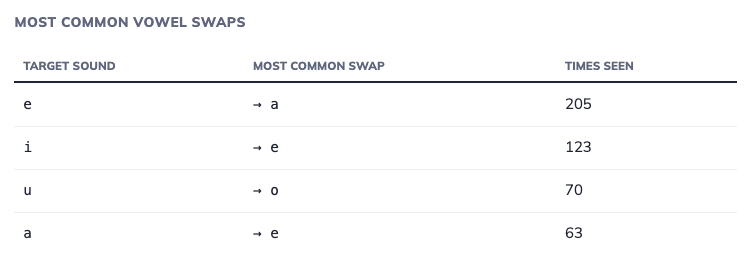
This is the classic short-vowel instability of early "partial alphabetic" spellers — students who have the right region of the mouth but haven't yet locked in exactly which vowel letter matches which sound. It's worth watching for in your own students' invented spelling, on the page or off.
Consonant clusters get simplified, not scrambled
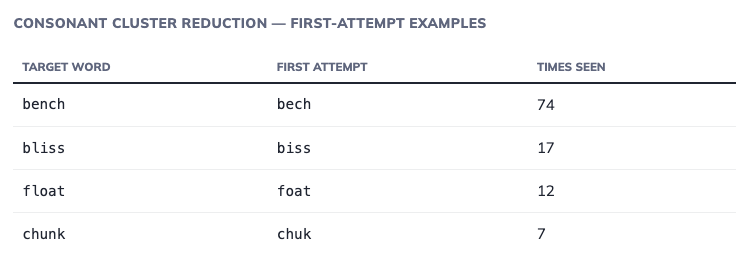
The second big pattern shows up in blends. Students don't misspell the whole cluster. Rather, they drop one letter out of it, almost always the harder-to-hear second consonant, or a nasal sound before a stop.
The Hardest Skills to Spell
Not every phonics skill is equally hard to spell. Multisyllabic words and silent letters are consistently the hardest — a pattern that shows up not just in the skill-category averages, but in individual lessons, where suffix-heavy content like -ly and -ed endings and multisyllabic vowel-consonant-e words are the toughest spots in the whole scope and sequence.
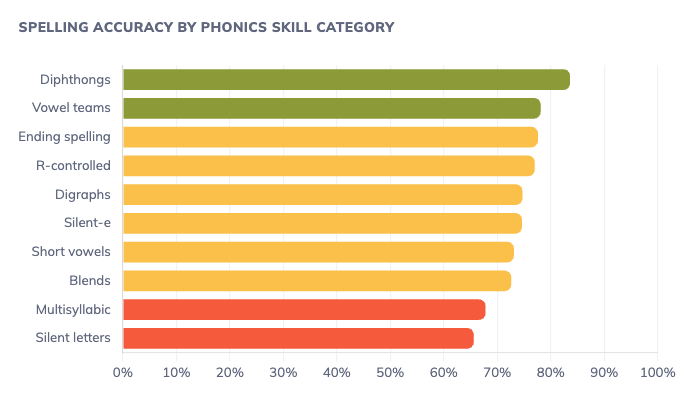
None of this is idiosyncratic. These are recognizable, well-documented fingerprints of phonics knowledge still under construction. This is especially true in multisyllabic and suffix territory, which is easy to under-teach in a packed literacy block. A quick look at a class's most-missed patterns can point straight to what your next small-group lesson should target, without waiting for a formal spelling inventory.
Does Spelling a Word Correctly Predict Reading It Correctly?
If a student spells a target word correctly in the warm-up, does that tell us anything about whether they'll read that same word correctly a few minutes later in the story?
In the data we have so far, the answer looks like yes.
Looking only at target-skill words a student both spelled in the warm-up and then encountered in the story: students who spelled the word correctly on the first try went on to read that same word correctly about 77.5% of the time. Students who missed the word in the spelling warm-up read it correctly about 67.2% of the time — a 10-point gap, on the exact same word, in the same reading session.
This difference is consistent with orthographic mapping: spelling and reading a word draw on the same underlying phoneme-grapheme map, so struggling with one showing up in the other tracks.
We should comment here that this was not a controlled comparison. We didn't have one group of students skip the spelling warm-up and another complete it, then compare their reading. Every student in this group completed the warm-up. However, we can say from the data that students who are generally stronger on a phonics pattern tend to look stronger on both the spelling and reading side of that same pattern, in the same sitting. We can't rule out that a generally strong reader would have read the word correctly regardless of the warm-up.
What we can say is that the spelling warm-up gives teachers a real-time signal. If a student stumbles on a target word during the spelling activity, there's a higher chance they'll stumble on that same word again a few minutes later in the story. Teachers can intervene within the same day or week, rather than needing to wait weeks or more for a screener or assessment.
A note on the data
Data reflects completed spelling warm-ups between March 15, 2026 and July 1, 2026. The data comes from real classrooms using LitLab's Student Fluency Platform. Figures describe this cohort's usage and are not the results of a controlled study.
Getting Started with LitLab's Student Fluency Platform
The spelling warm-up isn't a separate tool or an extra step for teachers to set up — it's built into every story on LitLab's Student Fluency Platform. Assign a decodable, recorded or silent, and your students get a quick spelling check on the story's target skill words before they ever start reading. No extra prep, no separate spelling list to pull together.
And because it's part of the same platform where you already review oral reading fluency data, spelling results show up right on your dashboard, with the option to listen back and see exactly where the phoneme-grapheme connection held or slipped.
See it with your own students' stories. If you're already using LitLab's decodable library, the spelling warm-up is part of the Student Fluency Platform. If you haven't tried the fluency platform yet, this is a good place to start.
Explore the Student Fluency Platform in the Help Center →
LitLab serves 5,000+ school sites and 400,000+ students across K–5. It meets ESSA Tier IV evidence standards and aligns to UFLI Foundations, CKLA, Fundations, Reading Horizons, Superkids, Benchmark, and other major phonics programs. 👉 Learn more to see how it fits with your current program.