
Case Study: Nashville Classical Charter School
Students were running out of decodables—and losing motivation. This case study shows how Nashville Classical Charter School used LitLab's personalized, curriculum-aligned texts to drive measurable fluency growth and reignite student engagement.
Nashville Classical Charter School: Driving Growth and Engagement with Personalized, Curriculum-aligned Decodables
👉 Read the full case study here
Background
Nashville Classical Charter School (NCCS) has always been rooted in the science of reading. As part of that commitment, they prioritized decodable texts in their early literacy instruction.
But over time, gaps in their existing materials began to show—particularly in the lower grades.
"Our options were severely limited," said Emma Colonna, Director of K-8 Humanities. "Students, especially in K-1, would run through the decodables quickly and get bored. Engagement and personal motivation dropped. We needed texts that could both support skill development and spark interest."
Compounding the challenge was the nature of decodables themselves: what's decodable for one student might be inaccessible to another if they haven't yet learned a specific sound-spelling pattern. Without a way to personalize texts based on individual mastery, teachers struggled to offer targeted practice.
Why LitLab
When Emma and her team encountered LitLab, the fit was immediate. The platform offered a rare combination of engagement, precision, and instructional alignment.
LitLab's Student Practice Platform allowed teachers to assign stories matched to each student's phonics needs. Stories were dynamic, customizable, and tied directly to phonics patterns being taught in Tier 1. For students, the experience felt fresh and relevant. For teachers, it added a powerful tool for reinforcing instruction and differentiating support.
"LitLab addressed multiple challenges at once. It increased student engagement, enabled data-driven practice, and aligned with our core phonics instruction. It was exactly what we needed."
— Emma Colonna, Director of K-8 Humanities, Nashville Classical Charter School
Implementation
NCCS launched a focused pilot in two classrooms—1st and 2nd grade—led by high-performing teachers Ms. Mullen and Ms. Ryan. The team was intentional about how the tool would be rolled out. Emma oversaw structural planning and served as the liaison with LitLab. Brigid, the Assistant Principal of K-2, supported implementation and coaching on the ground.
LitLab was used during the school's Tier 2 intervention block. While teachers worked with small groups, the rest of the class used LitLab independently. Teachers assigned decodable patterns weekly, based on data from AIMSWeb and CKLA. The weekly cadence allowed for rapid, responsive targeting of skills that students had not yet mastered.
"We didn't just drop a new tool in and hope it worked," Emma noted. "We had a clear plan, tight feedback loops with LitLab, and used our own data to make sure the implementation aligned with student needs."
Results
By the end of the year, the results stood out.
Both classrooms that piloted LitLab outperformed their peers on end-of-year benchmarks—not just in proficiency, but in student growth. These two classrooms were in the top quartile for growth nationwide. The second grade class, in particular, showed outsized progress despite serving a large number of students with intellectual and behavioral needs. Every student in both groups made gains in oral reading fluency.
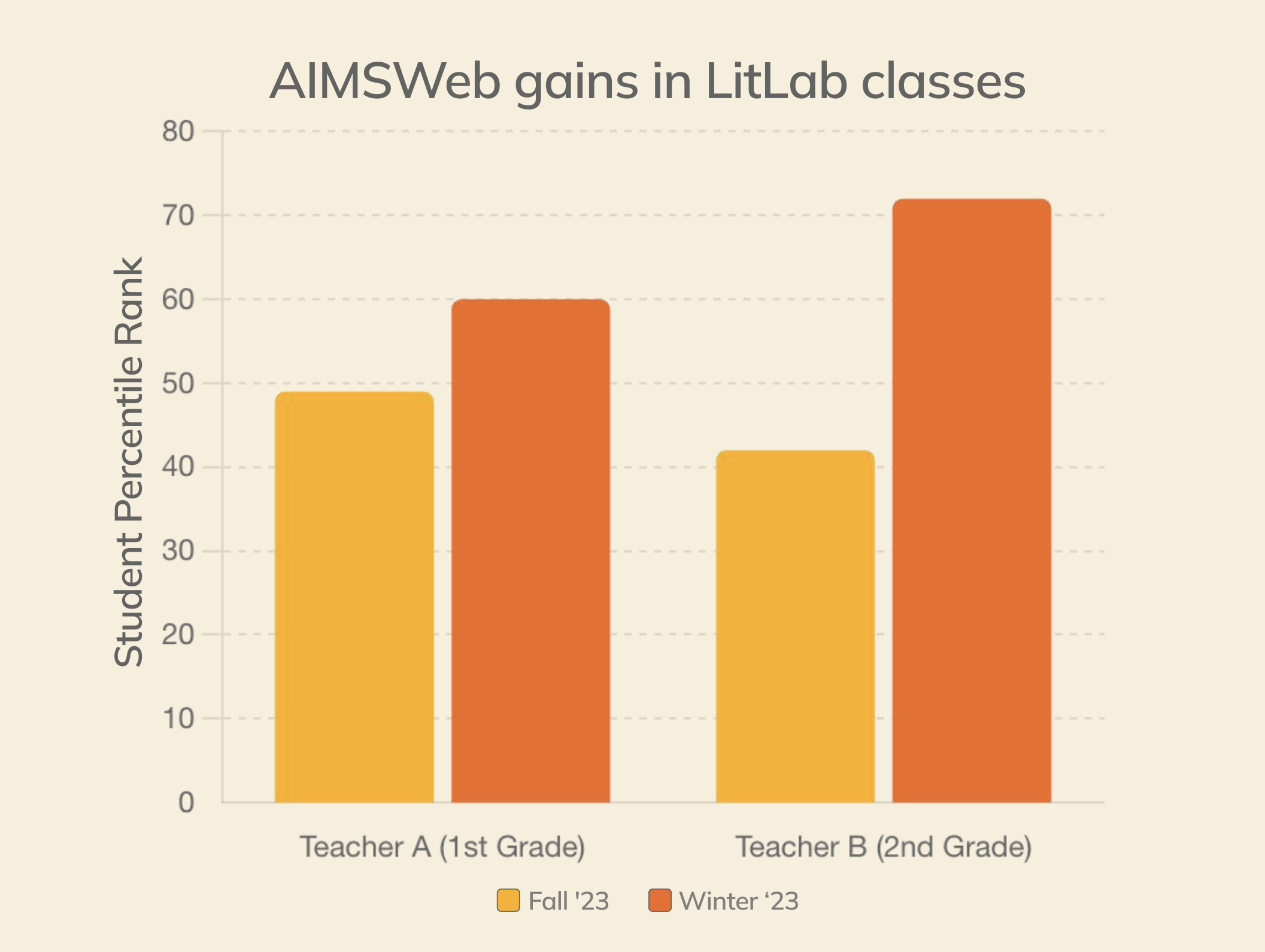
Student engagement saw a marked shift. Teachers reported sustained focus—15 to 20 minutes of independent use—and growing excitement around reading.
"LitLab supported the broader instructional ecosystem we had worked hard to build."