
AI and the Science of Reading
AI is everywhere in edtech — but not all of it belongs in an early literacy classroom. Here's how LitLab uses emerging AI to support the Science of Reading, and the principles that keep teachers in control.
There's a lot of AI in EdTech right now. Some of it is genuinely exciting. Some of it is a chatbot with a reading skin on top — content that isn't actually tied to a curriculum, a scope and sequence, or what a teacher taught that morning. As a provider of educational materials that are intended to be used by early learners, it's critically important to be transparent about how AI is used and incorporated into educational materials.
So, how does LitLab use AI? What's our philosophy?
The short version: We build tools that leverage emerging AI to handle the tedious parts: materials creation, curriculum alignment, and data analysis. Teachers get their time back and students get better-aligned practice. Teachers stay in control of the materials and instructional goals. Students never interact with a general-purpose AI. Every AI decision we make runs through one filter: does this actually serve the student's reading development?
That perspective comes directly from what the Science of Reading tells us about how young children learn to read.
Coherence Is the Standard
The Science of Reading is a growing body of evidence about how children learn to read. That research points consistently to reading growth being supported by a systematic process — one where phoneme awareness, phonics, fluency, vocabulary, and comprehension build on each other in a predictable sequence. Effective instruction follows that sequence explicitly, and practice needs to reinforce exactly what instruction has taught.
That alignment is what makes practice work. Research shows a 19% greater efficacy delta for aligned practice in Tier 1 instruction, and 27% in Tier 2 intervention. More practice isn't inherently better. More aligned practice is.
This is what makes AI tricky in early literacy. A tool that generates reading content without enforcing scope and sequence doesn't just fall short, it actively works against the coherence that structured literacy depends on. Every minute a student spends on content that doesn't match what they've been taught is a minute that isn't reinforcing the lesson.
Word recognition and phoneme sensitivity are among the strongest predictors of early reading development [3]. Decoding and oral language skills independently predict reading comprehension as early as second grade [2]. The stakes are real: students who don't read proficiently by third grade are four times more likely to leave school without a diploma [1].
Getting early literacy right matters. And that means getting the tools right, too.
The Problem with Most AI Decodable Generators
General-purpose AI, including tools that market themselves as decodable generators, can produce beginner-friendly text. What they can't do is enforce a phonics progression. They don't track which sound-spelling correspondences a student has been taught. They don't control for irregular words or patterns beyond a student's instructional level. They don't know what lesson happened this morning.
Decodability measures the percentage of words in a text that a student can decode using only the phonics patterns they've been explicitly taught — according to their specific scope and sequence. A word that's decodable in UFLI Foundations at lesson 40 might not be decodable in Fundations at the same point. True decodability isn't a fixed property of a text. It depends entirely on what a student has been taught, and when.
That's what makes most AI-generated content fall short. General-purpose AI has no concept of a scope and sequence. It can't know which sound-spelling correspondences your students have learned, which patterns are still ahead, or which words need to be pre-taught. The result looks like a decodable but isn't.
LitLab stories average 85%+ decodability, scored against the specific program a school has adopted. Nearly every word a student encounters has already been taught, in the right sequence, by their teacher. ChatGPT-generated texts, by comparison, score around 10%.
That gap matters. It isn't a leveled reader either. It's just words — with no verified skill alignment, no reliable Lexile, no A-Z level. It looks like instructional material and isn't. This is exactly the kind of incoherence that the Science of Reading asks us to move away from.
How We Use AI at LitLab
LitLab uses AI across four areas: generating decodable content, extending aligned practice to students, enabling accessibility (e.g. text to speech), and analyzing oral reading fluency. In every case, the AI works within strict curriculum constraints. Teachers stay in control. Students never interact with a general-purpose AI.
Custom Decodable Generators
LitLab's decodable generators are built on a proprietary Scope & Sequence Alignment system. Teachers can generate three types of content: fiction stories, nonfiction passages, and reader's theater scripts designed for partner or group reading. Every format is phonics-aligned to the same scope and sequence — so the skill focus stays consistent whether students are reading independently or performing with a partner.
Every generated decodable is bound by a specific phonics skill focus, controlled vocabulary lists drawn from the teacher's chosen program, and age-appropriate content parameters.
When a teacher generates a decodable, the AI produces a draft. The teacher reviews it, edits if needed, and decides whether to assign it. Finding the right decodable text used to mean endless searching for something that came close enough to the lesson — LitLab handles that heavy lifting, so teachers can create and assign curriculum-aligned stories directly, confident that every text reinforces exactly what they taught.
Teachers can assign decodables digitally or print them for hands-on reading. Five print formats are available (single image, read and draw, fully illustrated, compact story sheet, and booklet) so teachers can use them in the way that best fits their classroom.
LitLab also maintains a library of 1,500+ pre-made grab-and-go decodables, each built by literacy specialists and reviewed before publication. AI-generated and human-reviewed content work together within the same alignment system.
Student-Initiated Practice: Aligned Reading, On Demand
One of the hardest problems in early literacy isn't the whole-group lesson — it's what happens after it. Students who finish early, students who want to reread, students who need more repetitions with a specific skill before it clicks. Teachers can't generate new decodable material on demand for every student who needs it. Until recently, that meant reaching for whatever was on the shelf, which often meant reaching for something misaligned.
LitLab lets students generate their own decodable stories, but only within the exact same curriculum constraints their teacher already set.
When a student requests a new story, the system doesn't open a general-purpose AI and let them ask for anything. It reads the skill focus and scope and sequence from their active assignment and generates a new, original story within those same bounds. The phonics patterns are the same. The controlled vocabulary list is the same. The instructional level is the same. The only thing that changes is the story itself.
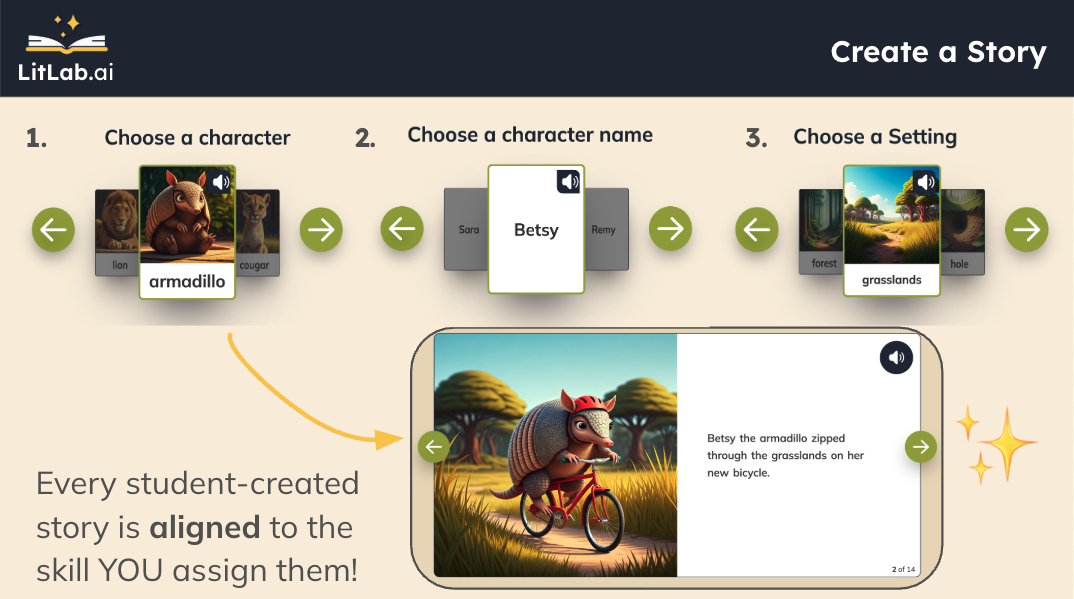
To make the student-initiated generation safe and improve accessibility, we significantly constrain the student interface. There is no text input, no open field, no prompt. Students can make three visual choices: a character, a name, and a setting — from curated, age-appropriate options presented as picture cards. That's the full extent of their input. The rest of the prompt is fixed by the system, and the curriculum constraint is always present. There is no way for a student to ask the AI anything.
This matters because in structured literacy, encountering the same phonics patterns across different texts builds the automaticity that fluency depends on. The Science of Reading is clear that massed, varied practice with high-decodability text accelerates pattern recognition in ways that a single exposure can't. The student decodable generator enables additional reading practice at the skill level the teacher has assigned for reading practice. In the 25-26 school year, students on LitLab have read over 240,000 additional stories created by themselves! Teachers regularly report it as one of their students' favorite moments in the platform.
Teachers retain full visibility. Student-generated stories appear in the same assignment view, and fluency recordings from those sessions feed back into the same skill-level data teachers already use. Nothing about the data model changes — the fluency practice simply has more surface area.
This is what curriculum-aligned AI practice should look like: not a chatbot, not a leveled reader dispenser, but a system that extends a teacher's instructional intent into the moments between lessons.
AI Fluency Analysis
When students read aloud in LitLab, their recordings are analyzed at the word and phoneme level. The platform surfaces accuracy data, comprehension scores, and reading rate — all mapped back to the specific skills in the teacher's scope and sequence through LitLab's Skill Maps.
Teachers can listen to every recording. They can validate or overwrite any automated analysis. Student recordings are processed for reading analysis only. They are not used by LitLab or by any of our AI vendors to train, fine-tune, or improve machine learning models. Our vendor agreements explicitly prohibit this.
AI surfaces the information. The teacher decides what to do with it.
What AI Doesn't Do at LitLab
- Students never interact with a general-purpose AI. LitLab is not a chatbot, and student-facing story creation involves no text input of any kind. Students make three visual choices — a character, a name, and a setting — from curated, age-appropriate options. That's it. The rest of the prompt is fixed by the system, and the curriculum constraint is always present. There is no way for a student to ask the AI anything.
- Student data is never used to train AI models. Our vendor agreements explicitly prohibit this.
- All AI-generated content is constrained by curriculum. Always.
[1] Hernandez, D.J. (2011). Double Jeopardy: How Third-Grade Reading Skills and Poverty Influence High School Graduation. The Annie E. Casey Foundation. https://files.eric.ed.gov/fulltext/ED518818.pdf
[2] Kendeou, P., van den Broek, P., White, M.J., & Lynch, J.S. (2009). Predicting reading comprehension in early elementary school: The independent contributions of oral language and decoding skills. Journal of Educational Psychology, 101(4), 765–778.
[3] Muter, V., Hulme, C., Snowling, M.J., & Stevenson, J. (2004). Phonemes, Rimes, Vocabulary, and Grammatical Skills as Foundations of Early Reading Development: Evidence From a Longitudinal Study. Developmental Psychology, 40(5), 665–681.